“Guess who” motif
The Woman in the WindowThe “Guess who?” motif begins as a familiar expression associated with Anna Fox’s family and becomes the signature of an intrusion into her home, computer, and sense of self. Ethan Russell turns the phrase into an email identity and a taunt, making his own surveillance look like Anna’s work. Its force comes from that reversal: what Anna recognizes as intimate family language becomes evidence that seems to implicate her in photographing herself.
A Familiar Phrase
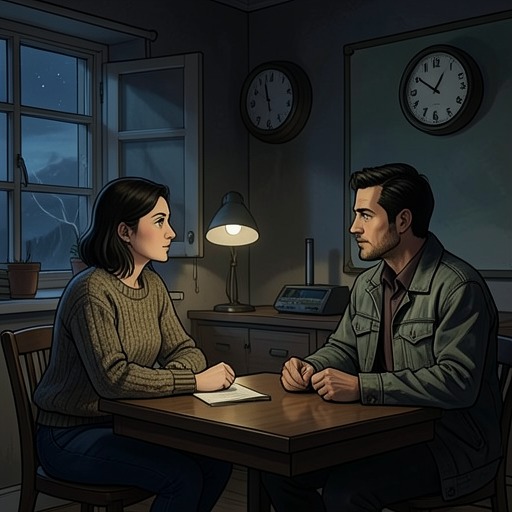
The phrase first appears as a brief, charged utterance in Anna’s narration. She does not want to talk to Ed, and the exchange is followed by his question about how she is feeling. The placement connects the words to a personal relationship without making their speaker or immediate meaning fully explicit in that moment. Later, however, Ethan explains the family association directly: Anna had told Lizzie that her family was always saying “guess who” when they spoke. The expression therefore carries a history of ordinary familiarity before it acquires its more threatening uses.
That personal detail matters because the phrase is not a randomly chosen password or subject line. Ethan has learned it from what Anna shared while trying to help Lizzie online. A piece of information offered in a comparatively open, supportive exchange becomes material for a deception Anna cannot initially explain. The motif marks the gap between the intimacy Anna attaches to a phrase and the access another person gains by listening to her.
From Identity to Evidence
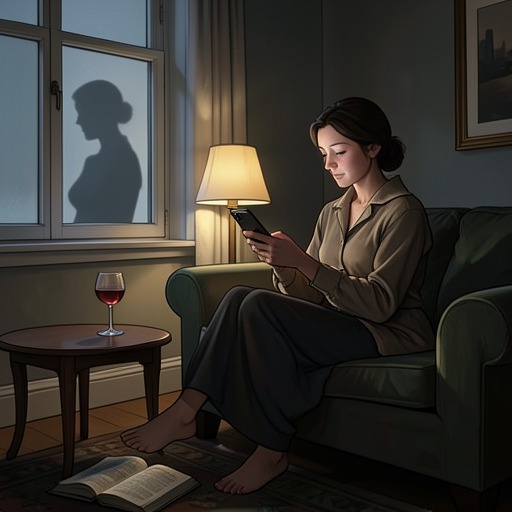
The words recur in a more disturbing form when Anna finds the photograph of herself asleep. She recognizes that the image has been sent through an email associated with “guesswhoanna.” The account name joins the familiar phrase to her own name, presenting the message as if its source were Anna. Rather than immediately identifying an outside intruder, she searches her own memory and wonders whether she created the account herself.
Her uncertainty has a concrete basis within the scene. Anna cannot remember making the account or sending the photograph, but she knows the phrase and recognizes it as belonging to her and her family. She recalls Val Norelli’s description of the image as a “Little midnight selfie,” and reasons that David has an alibi and that no one else could have accessed the bedroom. The apparent authorship and her missing memory pull in opposite directions: the more personally recognizable the message seems, the easier it is to treat her own recollection as the problem.
Anna tests the account rather than relying only on what she remembers. She opens the browser, goes to Gmail, and finds the username field already filled with “guesswhoanna.” That discovery turns the phrase into an apparent trace of her own actions. She concludes, “I really did this to myself. Guess who. Anna.” She also reasons that only she knows the computer password, so even the possibility that someone entered the house does not initially resolve the contradiction for her. The motif has shifted from an expression she knows to a piece of digital evidence that appears to confirm her self-accusation.
Ethan’s Construction of the Message
Ethan later supplies the missing history. After his first visit, he says, he created an account on the website he had seen on Anna’s laptop, hoping to make contact without writing to her unexpectedly. Through that account he encountered lonely people, including the person who connected him with Anna. This earlier online activity provides the route by which he gains access to personal information she had shared.
One of those details was Anna’s advice to Lizzie about making passwords by substituting numbers for letters. Ethan remembers the advice as a sign of her technical skill, but it also gives him a practical clue about her computer habits. He then explains that he created the Gmail account on Anna’s computer, choosing “guesswhoanna” because he knew the family phrase from her conversation with Lizzie. He sent the photograph of Anna asleep to that account and used her mother’s name on the account, anticipating that the choice would affect Anna. The seemingly self-authored message was therefore assembled from details Ethan gathered and deployed deliberately.
The disclosure reverses the evidence without making Anna’s earlier uncertainty foolish. Ethan had used Anna’s computer and personal language, so the username genuinely resembled something she might have made. By placing the image in an account tied to her own name, he converted his act of photographing her into a message that appeared to come from her. The motif is the hinge between surveillance and impersonation: Ethan does not merely watch Anna; he arranges for the record of that watching to accuse her.
Taunt and Reversal
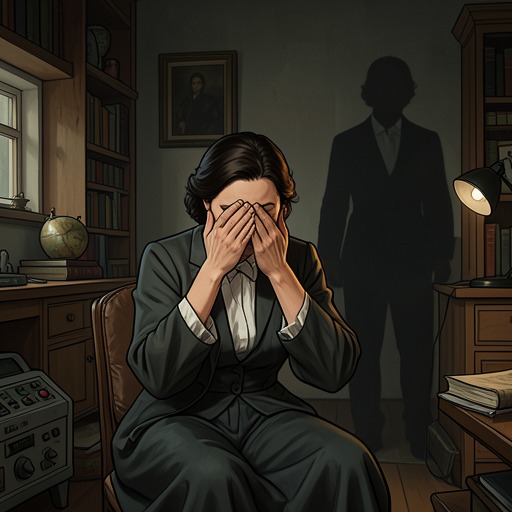
When Ethan finally repeats “Guess who, Anna?” he makes explicit what the email had concealed. The phrase is now no longer simply a family expression or suspicious account name. In Ethan’s mouth it announces that he knows what Anna said, has used it against her, and can expose the construction behind the photograph. The earlier question becomes a means of asserting control over what she can know about her own experience.
The motif’s progression depends on successive changes in apparent authorship. Anna first encounters a phrase with intimate associations; then she finds it attached to a photograph that seems to be her own secret; finally, Ethan claims responsibility for arranging both. Its recurrence links her conversation with Lizzie, her discovery in the email, her attempted verification on the computer, and Ethan’s confession. What had seemed to prove that Anna had secretly photographed herself instead reveals how thoroughly Ethan has turned her words and private spaces into instruments of deception.